

Many people begin wondering about ADHD after years of feeling overwhelmed, scattered, or emotionally worn down. They may notice that staying organized feels harder than it should, or that focus comes and goes in ways that never seem predictable. When ADHD is not clearly explained, people often assume these struggles are personal flaws rather than signs of how their brain works.
At Renova Wellness & Consulting, ADHD diagnosis starts with a real conversation. Joseph Gleed, LCSW, CCTP, CGP, has spent more than twenty years working with adults and families who want clear answers, not quick labels. The goal is to understand the full picture of someone’s life, not to rush toward a conclusion.
Why ADHD Diagnosis Is Not a Single Test
One of the most common myths about ADHD is the idea that there is one test that gives a simple yes or no answer. In real life, ADHD shows up as patterns that repeat across time and situations. A single questionnaire or appointment cannot capture that complexity.
Stress, anxiety, trauma, sleep issues, and burnout can all look like ADHD on the surface. That overlap is exactly why diagnosis takes time and context. A careful process helps make sure the focus stays on the real issue instead of chasing the wrong explanation.
Who Is Involved in Diagnosing ADHD
Many people are surprised to learn that ADHD diagnosis often involves more than one professional. Licensed therapists, psychologists, psychiatrists, and medical providers may all play a role in the process. Each one brings a different perspective to the evaluation.
Mental health professionals usually focus on attention patterns, emotional regulation, and life history. Medical providers may look at physical health, medications, or conditions that affect concentration. When these providers collaborate, the diagnosis is often more accurate and useful.
What an ADHD Evaluation Usually Includes
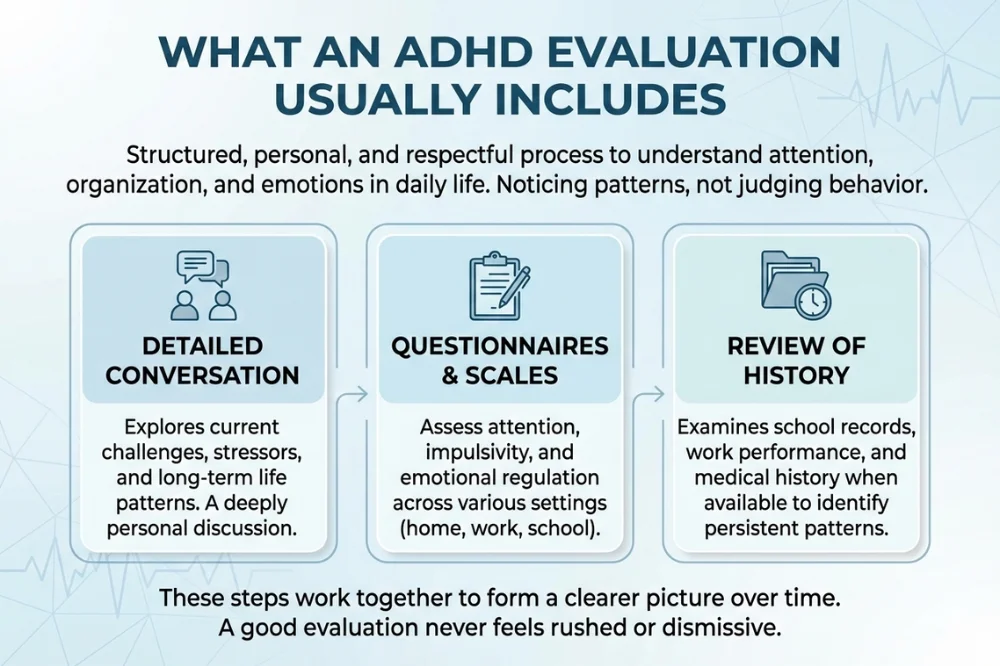
An ADHD evaluation is structured, but it should still feel personal and respectful. The purpose is to understand how attention, organization, and emotions affect daily life. It is about noticing patterns, not judging behavior.
An ADHD evaluation often includes:
- A detailed conversation about current challenges, stressors, and long-term life patterns.
- Questionnaires that explore attention, impulsivity, and emotional regulation across settings.
- Review of school, work, or medical history when that information is available.
These steps work together to form a clearer picture over time. A good evaluation never feels rushed or dismissive.
Looking at Childhood Patterns Without Pressure
ADHD does not suddenly appear in adulthood, even if it is first recognized later in life. Clinicians often look for signs that attention or regulation challenges were present earlier. This helps separate ADHD from conditions that develop later.
Many adults worry they need perfect childhood records to be taken seriously. That concern is understandable, but it is rarely required. Conversations about school experiences, early feedback, and long-standing struggles usually provide enough insight.
ADHD and Other Conditions That Can Look Similar
Several conditions can look like ADHD at first glance. Anxiety, trauma responses, depression, and sleep problems can all affect focus and emotional regulation. This overlap is one reason a careful diagnosis matters so much.
The table below shows some general differences, while recognizing that more than one condition can exist at the same time.
| Feature | ADHD | Anxiety | Trauma Response |
| Onset | Begins in childhood | Can develop at any age | Often follows traumatic events |
| Focus Issues | Ongoing and consistent | Driven by worry | Linked to safety scanning |
| Emotional Reactivity | Fast and intense | Fear-based | Trigger-based |
| Diagnostic Focus | Patterns over time | Current symptoms | Past experiences |
Understanding these differences helps reduce confusion. It also guides treatment in a more effective direction.
Why Self-Diagnosis Is Only the Starting Point
Many people read about ADHD online and feel understood for the first time. That moment of recognition can be validating and emotional. It often explains years of frustration in a way nothing else has.
Still, self-diagnosis has limits. A professional evaluation adds context, depth, and accuracy. It helps confirm what truly fits and gently rule out what does not.
The Emotional Side of Getting an ADHD Diagnosis
Getting evaluated for ADHD can bring up mixed emotions. Some people feel hopeful and relieved, while others feel nervous or uncertain. All of these reactions are normal.
For many adults, diagnosis is not about being labeled. It is about finally understanding why life felt harder for so long. That understanding often replaces self-blame with clarity and direction.
A Trauma-Informed View of ADHD Diagnosis
Not everyone seeking an ADHD diagnosis has trauma, but many people do. Long-term stress or high-impact experiences can shape attention and emotional regulation. Ignoring that connection can lead to incomplete answers.
Joseph Gleed, LCSW, CCTP, CGP, uses a trauma-informed approach that looks at the nervous system as a whole. At Renova Wellness & Consulting, diagnosis considers stress history, emotional safety, and regulation patterns alongside attention concerns.
What Happens After an ADHD Diagnosis
A diagnosis is not the end of the process. It is the starting point for building support that fits the individual. There is no single plan that works for everyone.
After diagnosis, support may include:
- Therapy focused on emotional regulation, coping skills, and nervous system stability.
- Practical strategies for organization, focus, and daily routines that feel realistic.
- Coordination with medical providers when medication or further evaluation is appropriate.
The focus is on steady progress that feels sustainable. Support should evolve as life changes.
When to Consider an ADHD Evaluation
If focus, organization, or emotional regulation consistently interfere with daily life, an evaluation may be helpful. These patterns are signals that support could make a difference. They are not personal failures.
Many adults in Riverton and nearby communities say that understanding ADHD changes how they see themselves. Once the pattern is clear, growth feels possible instead of exhausting.
Taking the Next Step Toward Clarity
Deciding to pursue an ADHD evaluation takes courage and honesty. It means asking deeper questions about how your brain works and what kind of support would actually help. That step alone often brings relief.
At Renova Wellness & Consulting, Joseph Gleed, LCSW, CCTP, CGP, helps people move from uncertainty to understanding. Scheduling a consultation can be a steady first step toward clarity and a more supportive path forward.
Frequently Asked Questions
Who can diagnose ADHD?
Why it matters: Many people feel unsure where to start and worry about seeing the wrong provider.
What you should ask instead: Which professionals are trained to evaluate ADHD accurately?
Answer: ADHD can be diagnosed by licensed mental health professionals and medical providers with appropriate training. When providers work together, the diagnosis is usually clearer and more helpful.
Sources:
https://www.cdc.gov/adhd
https://www.nimh.nih.gov/health/topics/attention-deficit-hyperactivity-disorder-adhd
Do adults need childhood records to be diagnosed?
Why it matters: Adults often worry they cannot access old records or remember early details.
What you should ask instead: How do clinicians evaluate childhood symptoms without documentation?
Answer: Clinicians look for consistent patterns that suggest early onset, even without formal records. Conversations about school experiences and early challenges usually provide enough context.
Sources:
https://www.nimh.nih.gov/health/topics/attention-deficit-hyperactivity-disorder-adhd
https://www.apa.org/topics/adhd
Can ADHD be confused with anxiety or trauma?
Why it matters: Misdiagnosis can delay meaningful progress and relief.
What you should ask instead: How do professionals tell ADHD apart from other conditions?
Answer: ADHD, anxiety, and trauma can overlap, but they come from different underlying processes. Trauma-informed assessment helps identify whether attention challenges are long-standing or stress-driven.
Sources:
https://www.nimh.nih.gov/health/topics/anxiety-disorders
https://www.cdc.gov/adhd
What happens after an ADHD diagnosis?
Why it matters: Many people worry diagnosis automatically leads to medication.
What you should ask instead: What kinds of support are available after diagnosis?
Answer: Support may include therapy, skills training, lifestyle adjustments, and medical coordination when appropriate. Care plans are personalized and flexible over time.
Sources:
https://www.cdc.gov/adhd/treatment