

Thinking about trying cognitive behavioral therapy for ADHD in Riverton, UT? You’re definitely not alone. Whether you’re a parent wanting to help your child feel more in control or you’re an adult trying to stop spinning your wheels, CBT offers real-world strategies that actually stick. It’s not just about learning what ADHD is. It’s about learning how to work with it, day by day and moment by moment.
At Renova Wellness & Consulting, Joseph Gleed, LCSW, CCTP, CGP, has helped hundreds of people feel less overwhelmed by ADHD. He’s not here to lecture or give you generic advice. He’s here to help you figure out what works in real life, not just in theory. With over 20 years of experience, Joseph makes CBT feel approachable and actionable. It becomes something you can actually use, and keep using.
What Is Cognitive Behavioral Therapy, Really?
Let’s break it down clearly. CBT is a structured and goal-oriented kind of therapy that helps you recognize the thoughts that throw you off track and replace them with more helpful ones. When you live with ADHD, those thoughts often sound like, “Why can’t I focus?” or “I always mess things up.” Those thoughts are more than just passing frustrations. They impact how you feel and how you act every single day.
CBT helps you interrupt those thoughts and build better responses. With ADHD, it’s easy to get stuck in cycles of procrastination, emotional outbursts, or mental shutdowns. CBT teaches you how to press pause and make a different choice. Whether you’re a teen in Bluffdale struggling with school or a parent in Parkside just trying to get through the day, this kind of therapy is built to meet you where you are.
Core CBT Techniques That Support ADHD Management
CBT isn’t about huge transformations overnight. It’s about steady progress that leads to long-term change. These strategies are simple but effective. They’re designed to target the everyday challenges ADHD brings, like poor planning, emotional reactivity, or difficulty getting started on tasks.
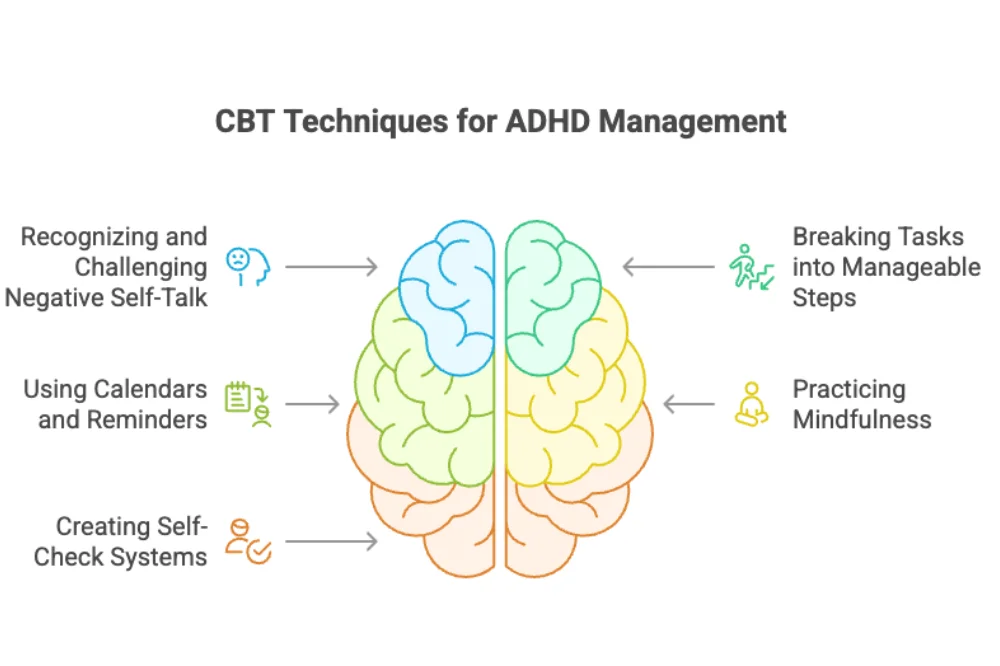
Before we introduce any tools, we talk about what your days actually look like. Then we build from there using real strategies such as:
- Learning to recognize and challenge negative self-talk instead of believing it.
- Breaking larger tasks into small, manageable steps you can actually finish.
- Using calendars, to-do lists, and reminders to stay on schedule and avoid forgetting important tasks.
- Practicing mindfulness techniques to slow down impulsive reactions.
- Creating simple self-check systems to stay more consistent and in control.
None of these tools are about forcing yourself into someone else’s routine. They’re about finding what works for you and making it feel sustainable. We’ve seen teenagers in Riverton South turn chaotic afternoons into focused work time. We’ve seen adults in Harvest Park finally feel like they have room to breathe. CBT becomes a way to support the life you already live, not add more pressure to it.
Is CBT Enough on Its Own for ADHD?
In some cases, CBT is enough on its own, especially when emotional regulation and self-defeating thought patterns are the biggest hurdles. It can help people feel more in control and reduce daily stress. However, ADHD is complex, and for many people, a more complete plan that includes CBT and other types of support is often more effective.
When medication is added, it can help clear the mental fog that makes focus so difficult. CBT then becomes easier to use, because the brain has more space to apply what it’s learning. Families from Rose Creek, West Jordan, and beyond often find that combining CBT and medication leads to faster and longer-lasting progress.
Other supports might also be helpful, depending on your specific needs. These can include:
- Parent coaching to create more structure and understanding at home.
- Collaborating with schools to get IEPs or 504 plans in place for better classroom support.
- Looking at how diet, sleep, and exercise affect energy and attention.
- Practicing calming strategies like breathing exercises or movement routines.
All of these tools work together to build a stronger foundation. CBT doesn’t have to carry the whole load by itself. But when it’s part of a broader plan, it becomes one of the most powerful tools you can have.
Comparing CBT to Other ADHD Therapy Options
With so many ADHD treatments available, it’s easy to feel unsure about where to start. Some people lean toward medication. Others prefer therapy or coaching. All are valid options, but each one works a little differently. CBT stands out because it gives you tools that help change the way you think, which then changes the way you respond.
To help you understand how CBT compares to other approaches, here’s a simple breakdown:
| Treatment Type | Focus Area | Works Best For |
| CBT | Thought patterns, emotional control | Teens, adults, kids with emotional reactivity |
| Behavioral Therapy | Habits, routines, consequences | Younger kids or structured environments |
| Medication | Brain function, focus | Moderate to severe attention issues |
| Parent Coaching | At-home routines, communication | Families with kids or teens |
| Mindfulness-Based CBT | Stress, awareness, emotional response | Adults and teens managing anxiety + ADHD |
All of these treatments can be helpful. The best choice depends on what you or your child needs most. At Renova Wellness & Consulting, we work with you to figure that out. We never force a one-size-fits-all plan. Instead, we help you explore the options and choose the approach that feels right.
What Real Progress Looks Like With CBT
CBT progress isn’t always obvious at first. It doesn’t always show up in test scores or neatly made beds. But it shows up in the way someone pauses before reacting. It shows up in the way they recover from a setback instead of getting stuck. These moments might be quiet, but they are meaningful.
You might notice that your child is asking for help instead of having an outburst. You might find yourself completing more of your daily tasks without feeling completely drained. Maybe you go through a whole day without feeling like a failure. That’s progress.
Families across Mountain View and Herriman Towne Center tell us they start to feel lighter once CBT becomes part of their routine. They feel less stuck, more hopeful, and more capable of handling the ups and downs. That’s what real progress looks like.
Taking the First Step Toward Support That Works
If you’re tired of struggling with ADHD, cognitive behavioral therapy can help you build a new kind of day. A day with fewer blowups, more focus, and a better sense of control. CBT helps you take one step at a time toward a version of your life that feels less overwhelming.
At Renova Wellness & Consulting, Joseph Gleed brings deep experience and real empathy to every session. He knows ADHD is not about laziness or lack of effort. It’s about having the right tools and support. That’s exactly what you’ll find here.
You don’t have to have it all figured out to get started. You just need to reach out. Call us at (801) 317-8522 or visit Renova Wellness & Consulting in Riverton. Here’s our location: Google CID.
Frequently Asked Questions
How is CBT different from traditional talk therapy?
People want to know whether CBT is “just talking” or something more structured that can directly help ADHD and anxiety in daily life.
What they should ask instead: How does CBT’s structure and focus make it especially helpful for ADHD and anxiety right now?
- Immediate Insight: CBT (Cognitive Behavioral Therapy) is more structured and skills‑based than many traditional talk therapies. Sessions focus on specific goals, practical tools, and homework, like tracking thoughts, practicing coping strategies, and testing new behaviors in real situations.
- Supporting Context: Instead of spending most of the time exploring the past, CBT emphasizes how current thoughts, feelings, and actions interact, and how shifting unhelpful thinking patterns can change mood and behavior today.
- Deeper Implication: For conditions like ADHD and anxiety, this problem‑solving style, clear goals, measurable skills, and between‑session practice, makes CBT one of the most researched and effective therapy models.
Does CBT work for kids with ADHD?
Families wonder when CBT is appropriate for children and whether it fits their child’s age and maturity.
What they should ask instead: At what age does CBT make sense for ADHD, and what works better for younger kids?
- Immediate Insight: CBT is usually most effective for children around age 8 and older, when they can reflect on their own thoughts, notice patterns, and talk about choices. At that stage, CBT can help with planning, self‑talk, and coping with emotions tied to ADHD.
- Supporting Context: For younger children, organizations like CHADD emphasize that parent training and behavioral programs (routines, rewards, clear expectations) tend to work better than classic CBT because adults control most of the environment and structure.
- Deeper Implication: As kids grow into tweens and teens, adding CBT helps them take more ownership, learning to catch unhelpful thoughts like “I always fail” and replace them with realistic, motivating ones while using concrete ADHD tools (timers, scheduling, checklists).
Can adults with ADHD benefit from CBT?
Many adults carry years of self‑criticism and stress; they need more than just organization tips.
What they should ask instead: How can CBT help with both the practical and emotional side of adult ADHD?
- Immediate Insight: Yes, CBT is strongly supported for adults with ADHD. It helps challenge long‑standing negative beliefs (“I’m lazy,” “I’ll never change”) and replace them with more accurate, helpful thoughts while building concrete systems for time‑management, prioritizing, and follow‑through.
- Supporting Context: Clinical trials show that CBT for adult ADHD improves core symptoms and related issues like anxiety and depression, especially when it includes skills training (scheduling, breaking tasks down, problem‑solving) alongside thought‑work.
- Deeper Implication: For many adults, CBT becomes a framework for rewriting their story, from “I’m broken” to “my brain works differently, and I can design tools that fit me”, which supports better work performance, relationships, and self‑esteem over time.
How long does CBT take to work?
People want realistic expectations so they don’t give up too early, or expect overnight transformation.
What they should ask instead: When do most people start noticing changes with CBT, and what keeps those gains going?
- Immediate Insight: Many people notice small improvements, like catching unhelpful thoughts sooner or getting started on tasks more easily, within a few weeks. Larger, more stable changes commonly take about 2–3 months of regular sessions plus practice between sessions.
- Supporting Context: Research on CBT and behavioral programs for ADHD shows that consistency matters more than speed: weekly sessions paired with real‑life homework (using planners, restructuring routines, practicing coping skills) predict stronger outcomes than occasional or irregular work.
- Deeper Implication: Continued or booster sessions over time help maintain progress, especially when life stressors change (new job, school demands). The skills you learn in CBT are meant to be reused and adapted, not just used during the formal treatment period.